Can You Get a Mortgage on a Prefab House? UK Lender Guide for 2026
By the The Modular Home Review team
Updated 2026
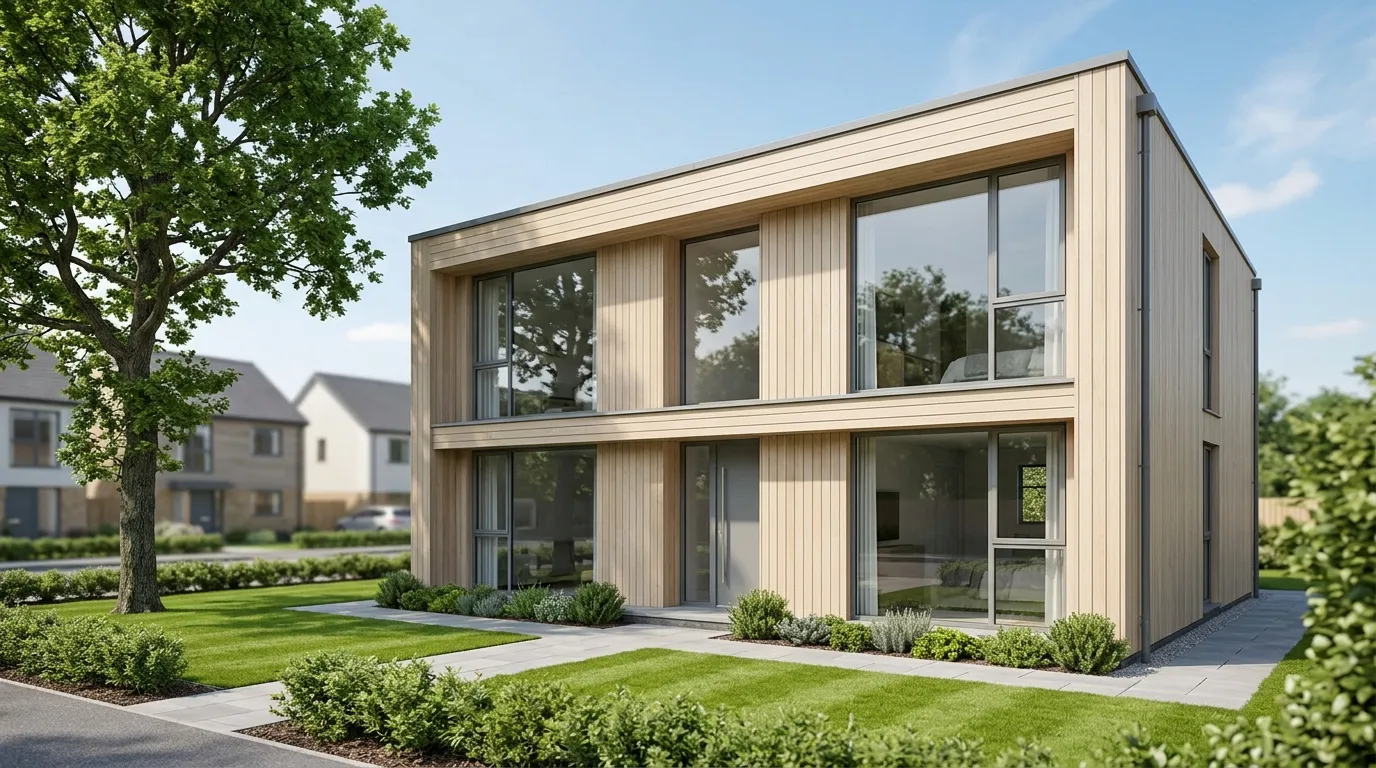
Yes, you can get a mortgage on a prefab house in the UK, but the lender pool is smaller and the deposit is usually larger than for a brick-and-block home. Lenders treat prefabs as “non-standard construction,” so the outcome hinges on the exact build type and the paperwork: an older designated-defective concrete house needs proof of an approved structural repair, while a modern factory-built home usually needs a recognised warranty or accreditation. Get those documents right and high street lenders such as Halifax and NatWest will consider the case.
The word “prefab” covers two very different things, and lenders look at each completely differently. Knowing which camp your property sits in is the first step.
The two kinds of prefab, and why lenders care
1. Post-war PRC (precast reinforced concrete) homes. Built from roughly 1945 onwards to plug a severe housing shortage, these used concrete panels and frames cast in factories. Many were later found to corrode internally as the steel reinforcement rusted. Under the Housing Defects Act 1984 (now carried into the Housing Act 1985), the government designated specific types as defective, including Airey, Cornish Unit, Dorran, Orlit, Reema, Unity, Wates and Woolaway homes, among others. Owners who had bought from the council under Right to Buy could claim help towards an approved repair. This is the category lenders worry about most.
2. Modern modular and MMC homes. These are today’s factory-built houses using timber frame, structural insulated panels (SIPs), light-gauge steel or volumetric modules, assembled offsite and craned into place. They are designed to current building regulations and, increasingly, carry warranties and accreditation built specifically to reassure lenders. A well-documented modern modular home can be close to as mortgageable as a traditional house.
If you are looking at a modern self-build or kit home rather than an ex-council concrete property, see our guide to self-build mortgages and stage payments for how the funding differs.
Can you get a mortgage on an older PRC prefab?
Often yes, but only once it has been repaired properly. The majority of lenders will not lend on a designated-defective PRC home in its original state. They want to see that the structure has been rebuilt or reinforced under an approved PRC licence, supervised by an approved inspector, and backed by a PRC Certificate of Structural Completion issued by a qualified structural engineer.
Some key points:
- A repair is usually non-negotiable. NatWest and Halifax, for example, will consider these homes case by case where the walls have been rebuilt in traditional materials and a PRC guarantee confirms the work.
- The certificate must come from the right person. Lenders want legal evidence of the repair, not just a verbal assurance from the seller.
- Guarantee length matters. Lenders vary, with many looking for a remaining guarantee somewhere in the 30 to 60 year range, though some set no minimum.
- Unrepaired homes need a very large deposit. Where a PRC home has not been structurally reinforced, the maximum loan-to-value is often around 50 per cent, so you would need roughly half the price in cash, if any lender will touch it at all.
You can check whether a property type appears on the official defective list and read the legislation on the legislation.gov.uk record of the Housing Defects Act 1984.
What makes a modern modular home mortgageable?
For a contemporary factory-built home, lenders look for evidence that the building system will last and stay saleable. Two pieces of paperwork do most of the work.
BOPAS accreditation. The Buildoffsite Property Assurance Scheme was developed with the Council of Mortgage Lenders and the Building Societies Association to assure lenders that an offsite construction system will be durable, and the property saleable, for a minimum of 60 years (two mortgage terms). It was built jointly with RICS and Lloyd’s Register. Major lenders including NatWest, Barclays, Nationwide and Santander draw confidence from it. You can verify a manufacturer’s status on the BOPAS register.
A recognised structural warranty. A 10 or 12 year warranty from a provider such as NHBC (Buildmark), Premier Guarantee or LABC covers defects in the early years and is something nearly every lender expects on a new build. NHBC also runs an “Accepts” scheme that assesses individual MMC systems against its technical standards.
In short: a modern modular home with BOPAS accreditation and a mainstream warranty behaves much like a standard property in a lender’s eyes.
Which lenders consider prefab mortgages?
There is no single answer, because acceptance depends on the build type and your wider circumstances. As a rough map:
| Lender tier | Typical appetite | Best suited to |
|---|---|---|
| High street banks (Halifax, NatWest, Nationwide, Santander, Barclays, HSBC) | Strictest criteria; accept modern timber frame and BOPAS-accredited MMC with a warranty, and repaired PRC homes case by case | Modern modular homes; fully repaired and certified PRC homes |
| Building societies (e.g. Ipswich) | Often more flexible; some lend on MMC self-builds and unusual construction | Self-builds and niche modern methods |
| Specialist lenders (Vida, Bluestone, Foundation, Pepper Money) | Will consider the toughest cases, including repaired ex-defective homes | Borrowers turned down elsewhere, usually via a broker |
Specialist lenders are typically only reachable through a mortgage broker, and their rates are higher to reflect the added risk. For most non-standard cases, going through a broker who knows the prefab market opens far more doors than approaching banks directly.
How big a deposit do you need?
More than for a standard house, and the figure swings with the construction type:
- Modern, warranted, BOPAS-accredited modular home: terms can be close to mainstream, sometimes with deposits in the region of 10 to 25 per cent depending on the lender.
- Repaired and certified PRC home: expect a larger deposit, commonly 25 to 35 per cent, which also widens your choice of lenders.
- Unrepaired PRC home: often capped near 50 per cent loan-to-value, so around half the value in cash.
A bigger deposit does two things: it shrinks the lender’s exposure to a property that may be harder to resell, and it materially increases the number of lenders willing to offer you a deal.
Surveys: why a structural engineer beats a basic survey
For any prefab, a standard valuation will not be enough. Lenders frequently insist on a specialist report, and you should want one anyway to know what you are buying.
For a designated-defective or older concrete home, a report from a chartered structural engineer who knows PRC construction carries more weight than a general RICS Level 3 (Building) Survey. The engineer can confirm whether repairs were carried out to the approved standard and whether the certification stacks up. For modern modular homes, a Level 3 survey plus the warranty and accreditation documents is usually the right combination.
You can find an accredited engineer through the Institution of Structural Engineers.
A sensible order to do things
- Identify the exact construction type (the estate agent, seller or a surveyor can usually confirm it).
- If it is a PRC home, ask for the PRC Certificate of Structural Completion and the repair licence before you go further.
- If it is modern modular, gather the BOPAS accreditation and warranty details for the building system.
- Speak to a broker who handles non-standard construction, rather than firing applications at high street banks.
- Budget for a larger deposit and a specialist survey from the outset.
Getting the documents lined up before you apply is the single biggest thing you can do to turn a “maybe” into a mortgage offer. For a wider view of unusual builds, read our guide to non-standard construction mortgages.
Frequently asked questions
Is a prefab house always classed as non-standard construction? Yes. Both older concrete prefabs and modern factory-built homes fall outside “standard” brick-and-block, so lenders apply their non-standard construction criteria to all of them, even the newest modular builds.
How long does a PRC repair guarantee need to last for a mortgage? It varies by lender. Many want a meaningful chunk of the guarantee remaining, often in the 30 to 60 year band, while some set no fixed minimum. Your broker can match the remaining guarantee to a lender that accepts it.
Can I get a mortgage on an unrepaired Airey or Cornish Unit house? It is very difficult. Most lenders will only consider these once they have been repaired under an approved scheme and certified. Without that, you are usually limited to a low loan-to-value, meaning a deposit of around half the price, or a cash purchase.
Do modern modular homes hold their value? A well-built modern modular home with a recognised warranty and BOPAS accreditation can hold or grow in value much like a traditional house. The accreditation exists precisely to reassure future buyers and their lenders that it will remain saleable.
Can I remortgage a prefab I already own? Yes, the same rules apply as for a purchase. The available lenders depend on the build type and your documentation, so a repaired-and-certified or BOPAS-accredited home will have more remortgage options than an unrepaired one.
Will I need a structural engineer’s report? For older concrete prefabs, almost certainly, and it should come from an engineer experienced in PRC homes. For modern modular homes, a Level 3 survey alongside the warranty and accreditation paperwork is usually what lenders ask for.
Independence note
We buy or borrow access to the builds we cover and accept no payment from manufacturers for reviews. If that ever changes on a given piece, we tell you at the top.
More from The Modular Home Review
All articles →
How Much Does a Modular Home Cost in the UK? 2026 Price Breakdown Per m2
Modular home cost UK: a 2026 per m2 breakdown covering the module, groundworks, connections, planning and the hidden extras most quotes leave out.
Do You Need Planning Permission for a Modular Extension? UK Rules Explained
Most modular extensions fall under permitted development and need no planning permission. Here are the UK size limits, prior approval and building regs rules.
SIPs vs Timber Frame: Which Is Better for a Modular Home?
SIPs vs timber frame for a UK modular home: airtightness, U-values, speed, cost, mortgages and warranties compared, with a clear pick for each scenario.