Permitted Development Rights for Garden Annexes and Modular Rooms
By the The Modular Home Review team
Updated 2026
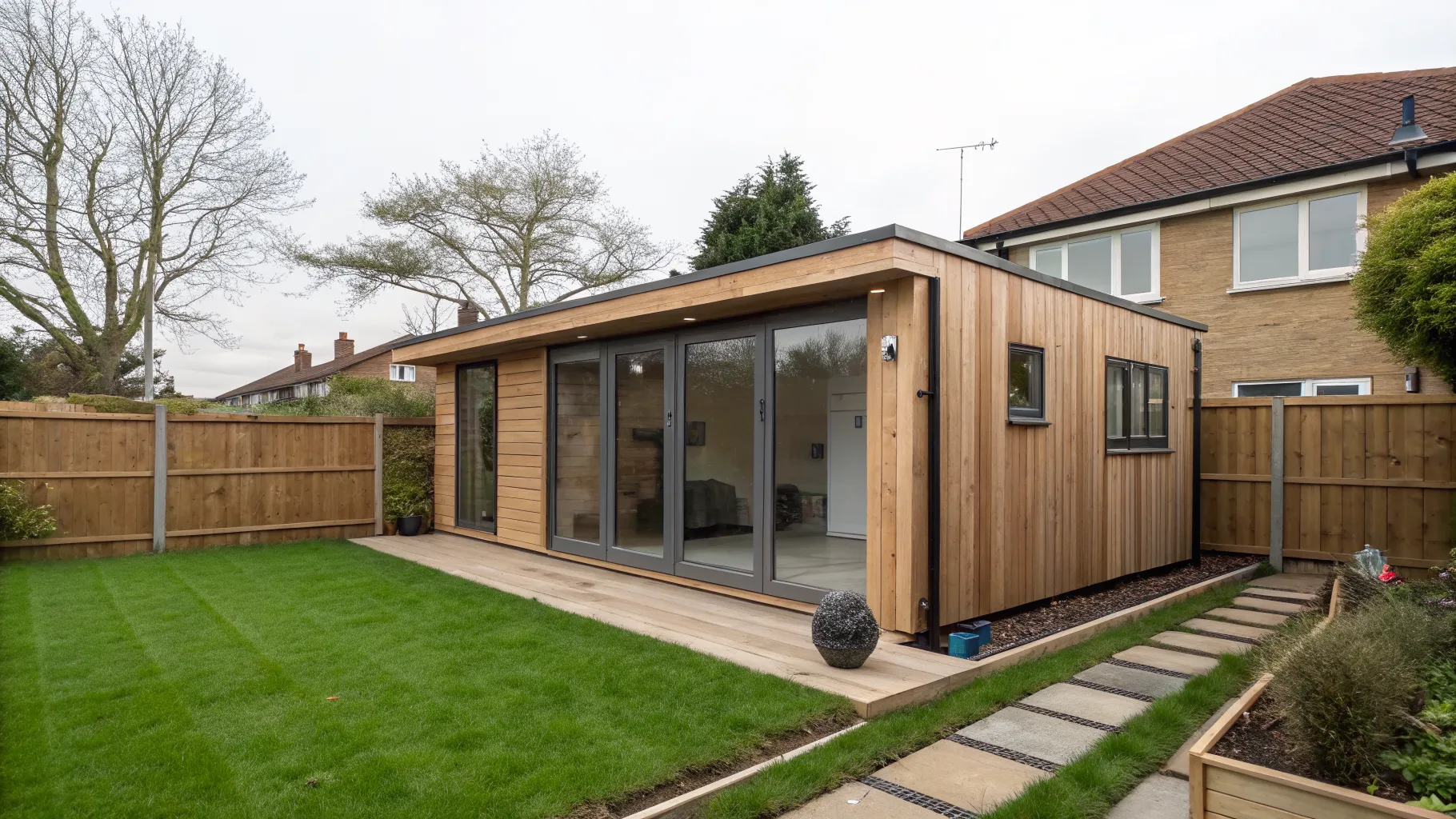
If you want a granny annexe under permitted development, the honest answer is that you almost certainly cannot. The phrase “permitted development garden annexe” gets searched constantly, but in England permitted development rights for a garden building only stretch to a structure used incidentally to the main house, like a home gym, office or hobby room. The moment a garden building becomes a self-contained place where someone lives, with its own sleeping, cooking and washing facilities, it falls outside permitted development and needs full planning permission. This is the single most misunderstood point in the whole subject, and getting it wrong is what lands people with enforcement notices. This guide explains where the line sits, what the size rules actually achieve, and how Building Regulations, Council Tax and enforcement fit around it.
Everything below is for England. Wales runs its own outbuildings rules, and Scotland and Northern Ireland have separate planning regimes.
Incidental versus ancillary: the distinction that decides everything
Permitted development for outbuildings sits under Class E, Part 1, Schedule 2 of the Town and Country Planning (General Permitted Development) Order 2015. Class E allows buildings “incidental to the enjoyment of the dwellinghouse.” That word, incidental, is doing all the work.
A garden room used as a study or a gym is incidental. A granny annexe is not. An annexe is ancillary accommodation: a separate, self-contained living space. The Planning Portal is explicit that permitted development does not cover use of an outbuilding as separate self-contained living accommodation, and the official technical guidance adds that any new building must not itself be separate, self-contained living accommodation.
So the test is about use, not appearance. A timber building you call a “garden room” becomes an annexe the day someone moves in permanently with a fitted bedroom, a full bathroom and a kitchen. Occasional guest sleeping, a sofa-bed used a handful of times a year, is generally accepted as still incidental. A permanent independent home is not.
The myth that size makes an annexe legal
Here is the trap. Plenty of pages tell you that if it is under a certain size you do not need permission for an annexe. That is false. The Class E size limits never legalise a self-contained dwelling. You could build something well within every dimension below and still need full planning permission, because it is the occupation, not the footprint, that triggers it.
The build method changes nothing either. A factory-built or modular annexe faces exactly the same planning test as a brick one. The planning category follows the use, not how it was constructed. If you are weighing up a prefabricated unit, the route is the same as any other annexe, which we cover in modular extension planning permission.
What Class E permitted development actually allows
For a genuinely incidental garden building, these are the core Class E conditions in England:
- Single storey only, with a maximum eaves height of 2.5 metres.
- Maximum overall height of 4 metres for a dual-pitched roof, or 3 metres for any other roof type.
- Maximum height of 2.5 metres if any part is within 2 metres of a boundary.
- Outbuildings and additions together must not cover more than 50% of the land around the original house.
- Nothing forward of the principal elevation: the building must sit behind the front wall of the house.
- No verandas, balconies or raised platforms, and a platform must not exceed 0.3 metres in height.
On designated land, conservation areas, Areas of Outstanding Natural Beauty, National Parks and the Broads, an outbuilding to the side of the house needs planning permission, and total floor area restrictions apply. For a listed building, any outbuilding within the curtilage needs permission. If your property falls into any of these categories, treat permitted development as off the table until a planner confirms otherwise.
If you want certainty that an incidental garden room is lawful without making a full planning application, apply for a Lawful Development Certificate from your local authority. It is the document that protects you if a future buyer or the council ever asks.
Building Regulations: a separate consent you cannot skip
Planning permission and Building Regulations are two different tracks. Planning asks whether you can build it here. Building Regs asks whether it is built safely. Passing one does nothing for the other.
A pure garden room under 15 square metres with no sleeping accommodation is generally Building Regs exempt. Between 15 and 30 square metres it can still be exempt if it sits more than 1 metre from a boundary or is built substantially from non-combustible materials. Anything over 30 square metres needs approval. An annexe is a different story. Because it contains sleeping accommodation, heating, insulation, electrics, drainage, plumbing and fire-safety provisions, it almost always needs Building Regulations approval whatever planning route you took. We go deeper into that approval process in modular building regs approval, and the groundworks side in modular home foundations.
Council Tax on a granny annexe
A self-contained annexe normally gets its own Council Tax band. The Valuation Office Agency decides case by case, looking mainly at whether there is independent access and the unit has its own sleeping and cooking facilities.
There are real reliefs, though. Since 1 April 2014, an annexe qualifies for a 50% Council Tax discount when it is used as part of the main home, or occupied by a relative of the main-house occupier. There is a full exemption, Class W, where the annexe is occupied by a dependent relative, defined as someone aged 65 or over, severely mentally impaired, or substantially and permanently disabled. A separate exemption, Class T, applies to an unoccupied annexe that cannot be let separately. The government sets out the broader picture in its guidance on how Council Tax bands are assessed.
The Caravan Act route
There is an angle most pages miss. Under the Caravan Sites and Control of Development Act 1960 and the Caravan Sites Act 1968, a twin-unit caravan, meaning a mobile-home-style annexe, can sometimes be sited as ancillary residential use without a standard build, provided it meets the legal caravan definition: moveable in no more than two sections, and no larger than 20 metres long by 6.8 metres wide, with a maximum internal height of 3.05 metres.
In practice, this is usually a safety net rather than a standalone shortcut. Established annexe firms tend to submit a Householder Planning Application as the primary route and lean on the Caravan Act as a fallback. Specialist suppliers such as iHus, Hawksbeck Annexes and Grannexe build to this model, and a true self-contained annexe in the UK typically runs into the tens of thousands of pounds. Always verify current pricing and specification directly with the manufacturer before committing. For a wider view of build costs, see modular home cost UK.
Enforcement: the four-year rule is gone
This is the part that catches people out, because so many older pages still get it wrong. The old four-year rule no longer applies. From 25 April 2024, under the Levelling Up and Regeneration Act 2023, a single 10-year enforcement time limit covers all breaches in England, including unauthorised operational development and unauthorised change of use to a dwelling. Developments substantially completed before 25 April 2024 keep the old four-year limit under transitional provisions. You can read the detail in the GOV.UK note on enforcement changes under the Levelling Up and Regeneration Act.
The practical upshot is that building an unauthorised annexe and waiting it out is now a far longer and riskier gamble. To regularise a long-standing unauthorised annexe, you apply for a Certificate of Lawfulness of Existing Use or Development, which demands robust evidence of how long the use has continued.
Frequently asked questions
Can you build a granny annexe under permitted development? No, not as self-contained accommodation. Permitted development under Class E only covers garden buildings used incidentally to the main house. A granny annexe is ancillary living accommodation and is explicitly excluded, so it needs full planning permission regardless of its size.
Can someone live permanently in a garden annexe? Only with full planning permission granting it use as ancillary, self-contained accommodation. Permanent occupation is exactly what takes a building out of the incidental category, so you cannot rely on permitted development for it.
Can you sleep in a garden room without planning permission? Occasionally, yes. A guest using a sofa-bed a few times a year is generally still treated as incidental use. Permanent sleeping combined with cooking and washing facilities reads as a separate dwelling, which needs permission.
Does a garden annexe need its own kitchen, bathroom and entrance? A true annexe usually has them, and those very features are what classify it as self-contained living accommodation. Adding a fitted kitchen, full bathroom and independent access is what pushes a garden building out of permitted development and into requiring planning permission.
Do you pay Council Tax on a granny annexe? Usually yes, in its own band set by the Valuation Office Agency. You may qualify for a 50% discount if a relative occupies it or it is used as part of the main home, or a full Class W exemption if it houses a dependent relative aged 65 or over, severely mentally impaired or substantially and permanently disabled.
What is the Caravan Act and can it avoid planning permission for an annexe? It allows a twin-unit caravan within set size limits to be sited as ancillary residential use. It is often used as a fallback rather than a guarantee, and most providers still submit a Householder Planning Application as the main route. If you are still researching options, our buying a modular home UK guide covers the wider decision.
Independence note
We buy or borrow access to the builds we cover and accept no payment from manufacturers for reviews. If that ever changes on a given piece, we tell you at the top.
More from The Modular Home Review
All articles →
How Much Does a Modular Home Cost in the UK? 2026 Price Breakdown Per m2
Modular home cost UK: a 2026 per m2 breakdown covering the module, groundworks, connections, planning and the hidden extras most quotes leave out.
Do You Need Planning Permission for a Modular Extension? UK Rules Explained
Most modular extensions fall under permitted development and need no planning permission. Here are the UK size limits, prior approval and building regs rules.
Can You Get a Mortgage on a Prefab House? UK Lender Guide for 2026
Yes, you can get a prefab house mortgage in the UK. Here is which lenders accept them, the deposit you need, and the certificates that make or break your case.